
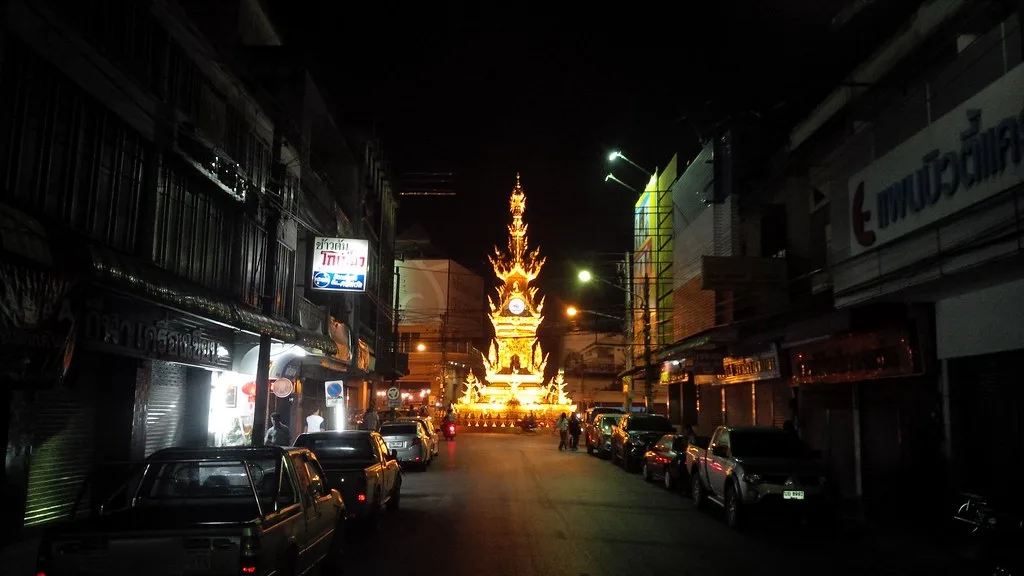
Chiang Rai Clock Tower: What to See and When to Go
Treat the Chiang Rai Clock Tower as a 15- to 30-minute evening stop, not a sight that justifies its own trip. It is a richly ornamented golden monument standing in the middle of a working traffic roundabout, and looking at it costs nothing. This guide covers where it sits, how to reach it, what you actually see by day and after dark, the announced show times and why you should confirm them on the day, and which nearby sights make the detour worthwhile.
What the Chiang Rai Clock Tower Is and Who Designed It
The tower is officially known as Hoh Nalika Chalerm Prakiat and is usually called the Golden Clock Tower by visitors. It was designed by Chalermchai Khositpipat, the artist behind Wat Rong Khun, the White Temple outside the city, which explains the elaborate gilded ornament rather than a plain civic timepiece. Sources disagree on the year it was completed and on which royal figure it honors—travel accounts describe completion in 2008 to honor King Bhumibol Adulyadej, while a photo caption says 2005 to honor Queen Sirikit—so treat any single date or dedication you read as unconfirmed and enjoy it as a contemporary landmark instead.
Knowing the designer matters for your expectations. The surface is covered in intricate relief work inspired by Lanna Buddhist art, so the tower reads more like an outdoor sculpture than a piece of street furniture. If you have already seen or plan to see the White Temple, the visual language will feel familiar and the stop becomes a free city-center sample of the same artist's style.
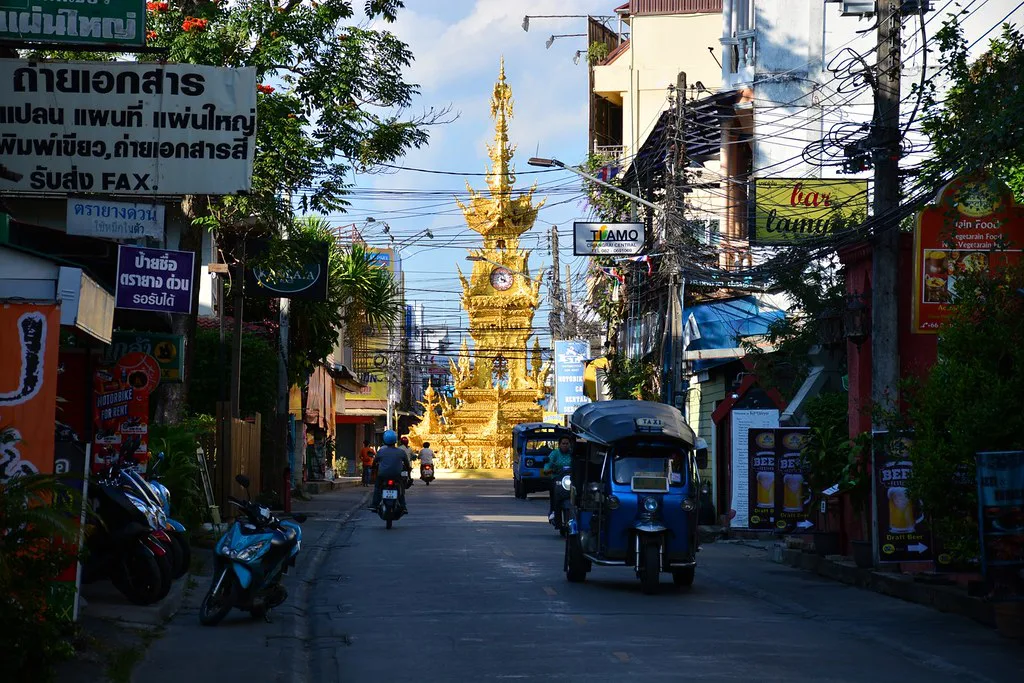
Where It Stands: The Roundabout at Banphaprakan and Jet Yot Roads
The tower occupies the roundabout where Banphaprakan Road meets Jet Yot Road in downtown Chiang Rai, a short walk from the Night Bazaar. Some listings also name Suk Sathit Road and Thanalai Road at the same intersection, so navigate to the junction itself rather than to a street address. The guide that documents the roundabout location places the Blue Temple about 2.1 km (1.3 mi) away and Baan Dam Museum about 9.9 km (6.2 mi) away as the crow flies, both approximate straight-line figures rather than walking routes.
Because the tower is a roundabout, there is no entrance, no gate and no ticket window. You view it from the surrounding pavement, which is why the location matters more than any opening time. Set your map pin on the intersection and plan to arrive on foot from the market side.
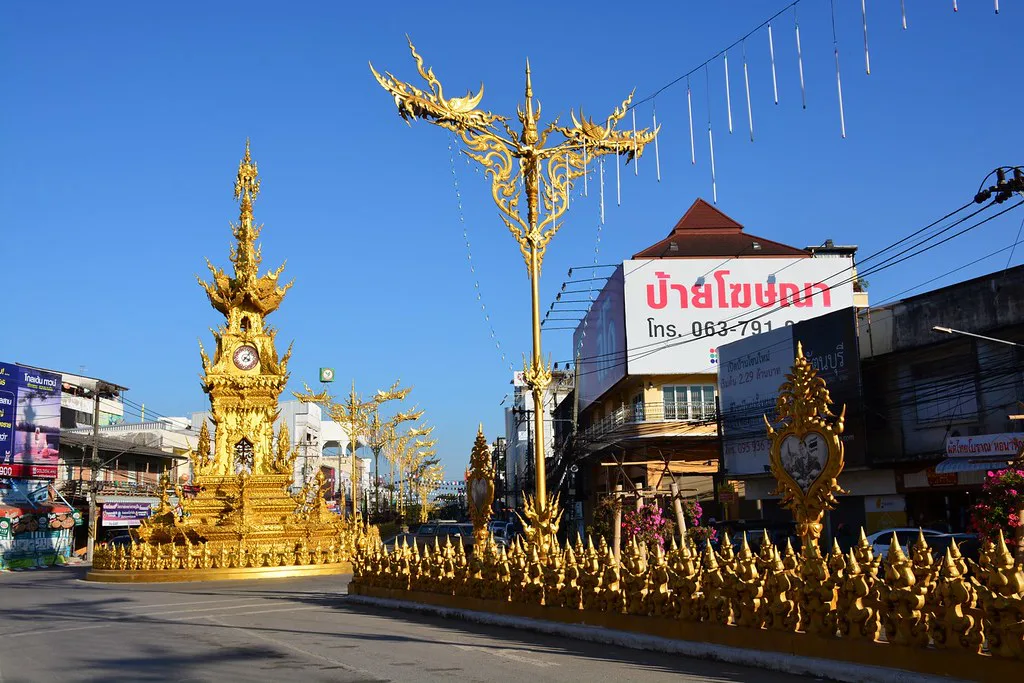
How to Get There and Where to Stand Safely
Most travelers reach the tower on foot, since it sits inside the flat, walkable city center close to the Night Bazaar and a cluster of downtown temples. If you are coming from further out, ask your hotel or a driver to drop you on the sidewalk nearest your chosen viewing side rather than circling the roundabout. Pavements in the area can be uneven and busy, so travelers with mobility needs may prefer a drop-off right beside the viewing spot.
Stand on the pavement and use marked crossings where they exist. Do not step into the roadway for a centered photo, and keep children close after dark when traffic and crowds both increase. The tower is not a pedestrian plaza, and no part of the experience requires you to enter the circle.
What You Actually See: Gold by Day, Illumination After Dark
In daylight the tower shows off its golden reliefs and three-dimensional patterns, and late afternoon sun brings out a deep orange glow on the metalwork. Many visitors find the hour before sunset the most photogenic, when the color warms up but the lights have not yet taken over. A daytime look takes only a few minutes, so combine it with a walk to the nearby temples.
After dark the tower is illuminated and becomes a glowing centerpiece for the surrounding cafes, restaurants and massage shops. Travel writing describes the lighting shifting through blues, pinks, purples and gold to a musical soundtrack, while a separate visitor account recalls pockets of changing color with light Thai background music for about ten minutes each hour from 18:00 to 22:00. That recollection does not align with the 7 pm, 8 pm and 9 pm pattern most guides report, so plan around the schedule announced on the day rather than either recollection.
The Nightly Light and Sound Show: Announced Times and Why to Confirm
Travel guides consistently report the sound-and-light presentation at 7 pm, 8 pm and 9 pm, commonly citing tourism-authority material, though no official tower operator is documented and the underlying authority listing is not reproduced here. That makes these operational details rather than a promise: rain, festivals, roadworks and national holidays can cancel or shift a show at short notice. Confirm the current time locally on the day, ideally through your hotel or the tourism authority, before you build dinner around it.
Arrive 10 to 15 minutes before the announced time so you can pick a clear, safe viewpoint on the sidewalk without rushing across traffic. The presentation is brief, so there is little point in camping out for an hour. If you are visiting in the wet season, bring a light rain layer and keep a fallback plan for dinner indoors.
How Much Time to Allow, and What a No-Show Evening Still Offers
Budget five to 15 minutes for a photograph stop if no show is running, or roughly half an hour if you stay for a timed presentation. That makes the tower an easy add-on to a dinner or market evening rather than a half-day outing. If the show is cancelled, the illuminated tower and the surrounding food and market streets still fill the evening comfortably.
This is where the tower suits some travelers better than others. Families, photographers and short-stay visitors get the most from a quick visit, while travelers chasing deep history or museum exhibitions should spend their hours elsewhere and treat the tower as a passing look.
Tickets, Hours and Closures: What Is Free and What to Verify
Looking at the tower is free, because it stands in a public roundabout with no admission gate. Nearby dining, market shopping and parking are commercial and priced independently, so check those costs on site rather than relying on any figure you read online. There are no published opening hours or closure schedule for the tower itself, and no ticket office to contact.
The only details worth verifying are the show times, which are operational and can change. Check them the same day through your accommodation or the Tourism Authority of Thailand's current Chiang Rai material. If you cannot confirm a show, go anyway for the lighting and the atmosphere.
Photographing the Tower Without Stepping Into Traffic
The best photographs come from the pavement with a moderate zoom, not from the roadway. A zoomed shot flatters the gilded reliefs and keeps you clear of moving vehicles. At night, brace your phone or camera against a railing or wall to steady a longer exposure.
Walk the perimeter to find the side where the light falls best and where a crossing gives you a clean angle. Give other pedestrians room, and skip any shot that requires you to stand in the circle. A little patience with passing traffic usually beats a risky position.
Nearby Options to Pair With the Visit
The Night Bazaar is the natural companion, a short walk away and open into the late evening for food and shopping. Wat Phra Kaew Chiang Rai, one of the city's oldest and most revered temples and the reported original home of the Emerald Buddha now kept in Bangkok, is also within walking distance of the tower and pairs neatly with the same evening. For a broader set of options, see our Chiang Rai Attractions: 5 Visitor Guides.
If you have a car or a driver, Wat Phra That Doi Chom Thong makes a hilltop counterpart to the flat city center. City-center art and culture stops such as the Oub Kham museum suit travelers who want more than a landmark photo and can absorb the extra hours. Keep the rest of the itinerary as add-ons rather than turning one evening into a checklist.
Is the Clock Tower Worth the Detour?
Yes for families, photographers and anyone with a spare evening near the Night Bazaar, because the stop is free, short and visually striking after dark. Skip a dedicated trip if you want history or exhibitions, since the tower offers no interior, no collection and no ticket office. Check the same-day show time, stand on the pavement, and let the glowing clock face launch your evening rather than define it.
Explore more Chiang Rai guides
Sources
- Chiang Rai Clock Tower in Chiang Rai: 1 reviews and 7 photos
- Clock Tower Chiang Rai - Chiang Rai, Thailand Attraction
- Exploring Chiang Rai, Thailand: On Temples, a Golden Clock Tower, and Dancing Shrimp at the Night Bazaar | Will Fly for Food
- The Golden Clock Tower: The Radiant Icon of Chiang Rai’s Nightlife. | Trip.com Chiang Rai