
Rajabhakti Park in Hua Hin: What to See, How to Get There, and How Long to Allow

Rajabhakti Park is worth about an hour of your Hua Hin trip if you want the statues and the plaza, and closer to two if you add the museum building and a slow walk of the grounds. It is a memorial park rather than a theme park, built by the Royal Thai Army and named by King Bhumibol Adulyadej to express public loyalty to the monarchy, according to the park's own visitor guide. The park sits in Nong Kae, south of Hua Hin town toward Khao Takiab, so it fits naturally into a beach-and-temple half day.
What Rajabhakti Park Is
The park is a historically themed open-air site honoring past Thai kings from the Sukhothai period through the Chakri dynasty, and it was built by the Royal Thai Army with funds donated by public and private sectors. The Tourism Authority of Thailand's directory describes the grounds as covering roughly 355,200 square meters of Army land, which is why the site reads as a long, formal approach rather than a compact garden. Treat it as a place of national remembrance: people come to look, photograph and pay respect.
Where Exactly It Is in Nong Kae
Rajabhakti Park lies in Nong Kae subdistrict in Hua Hin district, Prachuap Khiri Khan Province, on the coastal side of town toward Khao Takiab. The practical landmarks are Khao Takiab, the hilltop temple headland south of Hua Hin, and Suan Son Pradipat beach further along the same coastal road. Use those two names when you give directions to a driver.
Because the park is south of the town center, do not plan on walking there from the night market or the Hilton area; it is a short vehicle ride. For the wider spread of sights around town, work from the overview of Hua Hin Attractions before you fix your route, since the town's stops are strung along the coast and inland.
The Seven Kings and Why Each Was Chosen
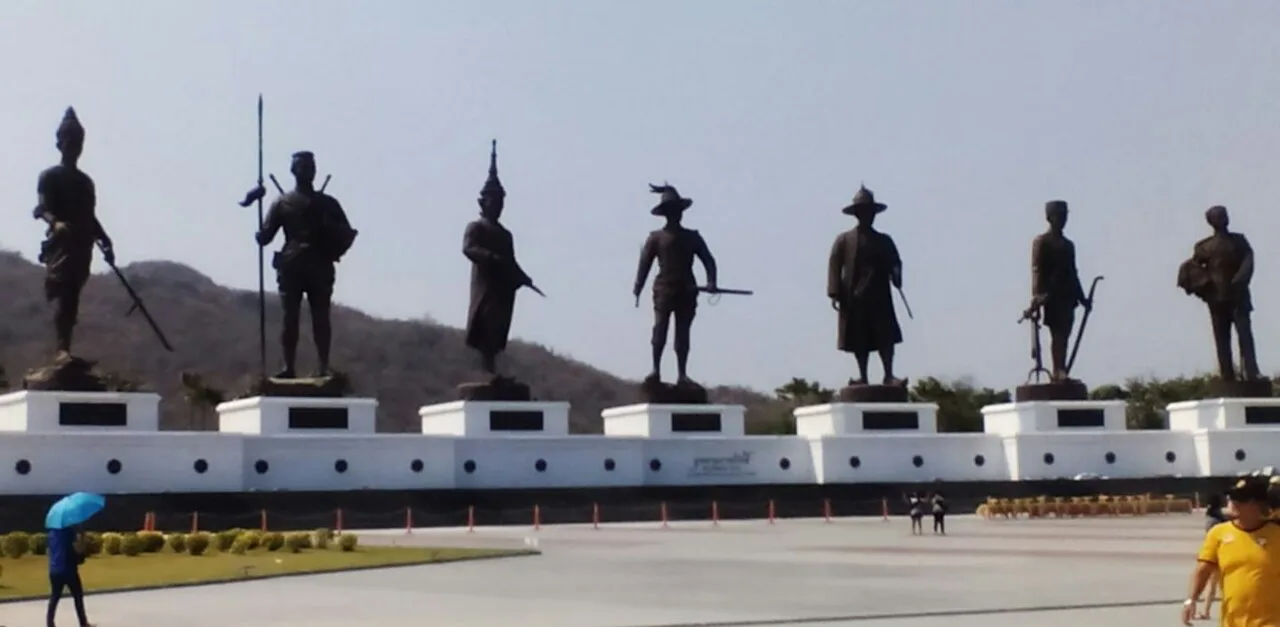
Seven bronze statues line the park, each representing a monarch judged to have decisively shaped Siam. The park's guide names King Ram Khamhaeng the Great of Sukhothai, credited with creating the Thai alphabet and establishing Theravada Buddhism; King Naresuan the Great of Ayutthaya, remembered for declaring independence from Burmese rule; and King Narai the Great, whose reign opened Siam to European diplomacy and trade. The remaining four are King Taksin the Great, who reunified the kingdom after the fall of Ayutthaya, and the Chakri kings Rama I, Mongkut and Chulalongkorn, honored for founding Bangkok and for modernizing the country.
What the Grounds Look Like
Expect a wide ceremonial plaza with the statue row on one side and a museum building on the site; the park's guide lists those three elements as its core features. The scale is the point: the statues are monumental bronzes, roughly 14 meters tall on average as reported by the park, and the flat plaza makes them look larger. Most visitors spend their time looking up rather than wandering far.
How to Get There from Hua Hin
The simplest approach is a taxi, ride-hailing car or hotel-arranged car from Hua Hin town, which drops you at the entrance without a walk along a fast road. Self-drivers will find parking at the site, and the coastal road south toward Khao Takiab is straightforward if you are comfortable driving in Thailand. Agree the waiting time and total fare before you set off, since meter use is inconsistent.
Many visitors combine the park with a Khao Takiab stop, since the temple headland is close by on the same road; a driver can wait at one while you see the other, which is often cheaper than two separate hires. If you are heading further south afterward, Suan Son Pradipat beach is on the same coastal stretch and makes a natural second stop.
How Much Time to Allow
For the statues and plaza alone, budget about 45 minutes to an hour: enough to walk the row, read the plaques and take photographs without rushing. If you also want the museum building and a slow circuit of the grounds, plan on roughly 1.5 to 2 hours, more if you are stopping often for shade. The site is exposed, so the temperature often sets the length of your visit.
Dress Code and Etiquette
This is a royal memorial site, so cover your shoulders and knees and avoid beachwear, tank tops or anything you would wear straight off the sand. The park's guide publishes an official dress code and etiquette section, and that page is the one to read before you go rather than relying on secondhand advice. Keep your voice down, and do not climb on the plinths or touch the bronzes.
Opening Hours, Admission, and Museum Access
The park's visitor guide carries sections on opening hours and admission, but published times and any charges can change with the season and with ceremonial events, so confirm them directly with the park or the Tourism Authority of Thailand before you travel. Do not build a tight schedule around an assumed closing time; leave an alternative nearby in case the gates are shut for an event. Check the listing the day before you go.
Best Time of Day and Heat Management
Go early or go late. The park's guide recommends the late afternoon for cooler air and sunset light and notes that crowds peak after about 10 a.m.; morning light is also good on the statues. Midday is the worst of both worlds: hard light, strong heat and reflective paving across a large open plaza.
What Is Nearby
Khao Takiab, the headland temple with the seated Buddha overlooking the sea, is the closest companion stop and is usually paired with the park. Suan Son Pradipat beach, a long, quiet stretch backed by casuarina trees, sits on the same coastal road and suits a post-visit swim or lunch. Both are close enough to reach in a short drive, which is why the park works best as part of a south-coast loop.
If you have a car and a full half day, Pranburi Forest Park further south adds a mangrove boardwalk, though it is a separate outing rather than a walk from the statues. Inland, Wat Huay Mongkol is a large, busy temple complex centered on the revered monk Luang Phor Thuad, and it pairs well with a morning that starts at the park. For a different side of Prachuap Khiri Khan's attractions, the Royal Hua Hin Golf Course in town is the historic seaside layout dating to the 1920s.
Common Mistakes to Avoid
One common mistake is skipping the historical context and then finding the statues look alike; read the plaques or a short summary beforehand and the row becomes legible. And do not assume the museum is open just because the gates are, since access can vary by day and by event. A quick check before you leave your hotel saves a wasted ride.
A Practical Checklist Before You Go
Finally, slot the park into a route rather than treating it as a standalone outing: pair it with Khao Takiab or the beach, and keep a backup plan in case of a ceremony. For more on how this site sits among the town's other stops, such as the Klai Kangwon Palace, the full list of things to do in Hua Hin is the place to start.
Is Rajabhakti Park Worth the Trip South?
Yes, if you want a compact, dignified look at Thai royal history and monumental photographs, and if you are already heading toward Khao Takiab or the southern beaches. No, if you are after entertainment or a shaded garden stroll; the plaza is exposed and the visit is short. Budget an hour, arrive early or late, dress modestly, and confirm hours and museum access before you go.