
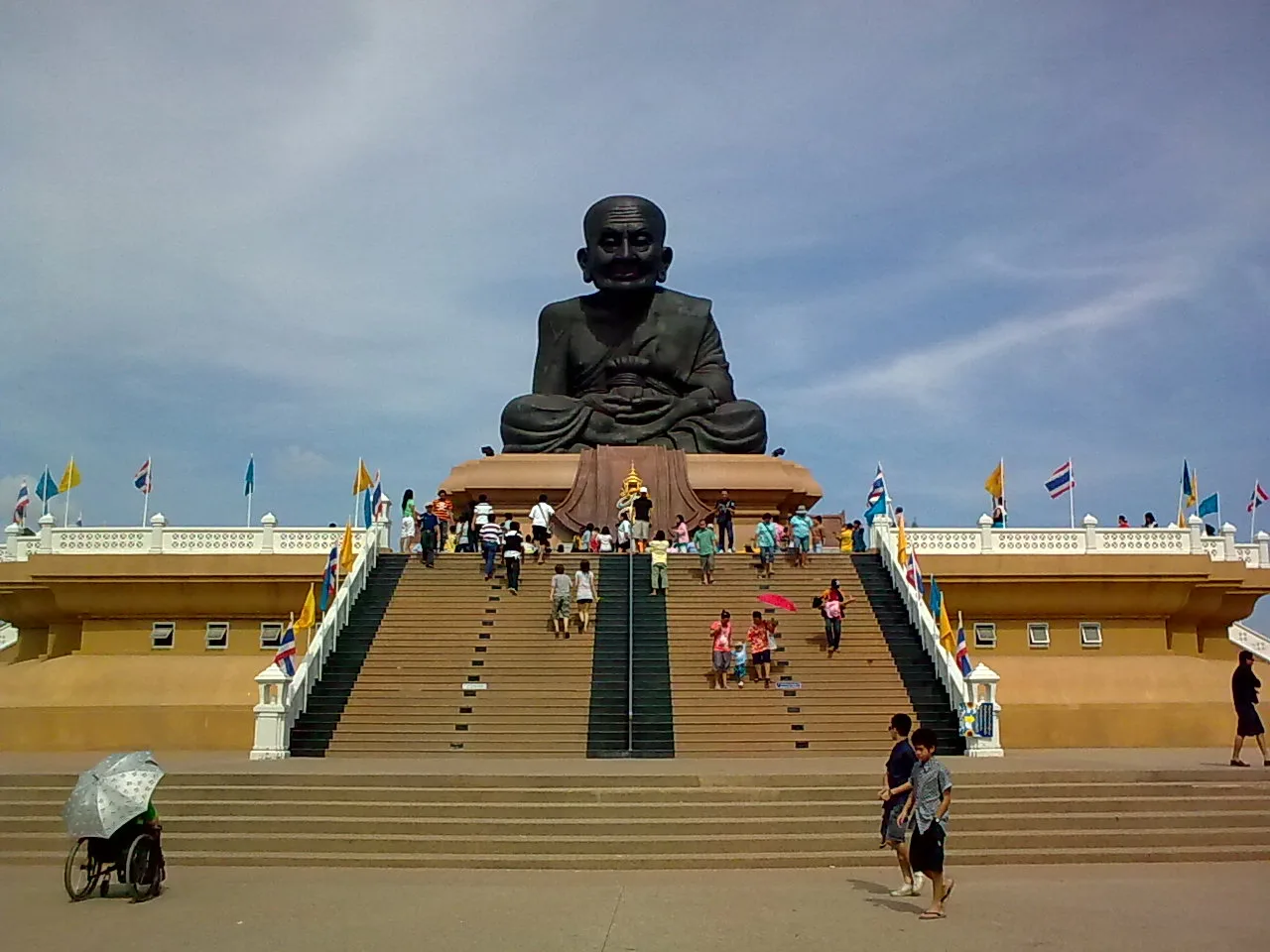
Wat Huay Mongkol: A Practical Guide to Hua Hin's Giant Monk Statue

Wat Huay Mongkol is a temple complex west of Hua Hin whose main draw is a colossal statue of the revered monk Luang Phor Thuad, set on a raised mound and visible long before you reach the steps. Most visitors spend about an hour here, and the site is free to enter according to the temple guide published by THAI.LT. This page covers where the temple sits, how to reach it without public transport, what to see on the grounds, and how to behave at a site that functions primarily as a pilgrimage destination.
The statue is the reason most people come, but the surrounding complex rewards a slower lap: a lake and garden, an artificial waterfall and cave, stalls selling offerings, and a monument to King Taksin the Great in front of the monk. Because the site draws Thai worshippers from across the country rather than tour buses alone, your timing and behavior matter more here than at a purely scenic stop.
What Wat Huay Mongkol is and why Thais travel to it
Wat Huay Mongkol honors Luang Phor Thuad, a monk venerated in southern Thailand and credited in local tradition with miracles, including turning seawater into fresh water. Those stories are devotional tradition rather than documented history, and they explain why amulets bearing his image are so widely worn. The temple was originally called Wat Huay Khot before taking its present name.
This is not a tourist attraction with a ticket booth and an audio guide; it is an active place of worship that happens to be monumental in scale. Thai families come to make merit, offer flowers and incense, and walk the elephant circuit, so you will share the grounds with people for whom the visit is religious. Plan your own behavior around that, and the stop becomes far more interesting than a photo opportunity.
Where it is: Ban Huay Khot, about 15 km from Hua Hin
The temple sits in the Ban Huay Khot area of Prachuap Khiri Khan province, roughly 15 km west of Hua Hin town. If you are navigating by landmark, the practical reference is the Nong Taphao Intersection: from Hua Hin you take the Nong Plub–Pa La Ou route, marked as Highway 3218, and continue straight to the temple.
Because the temple lies outside the city grid, a maps app is more reliable than sign-following once you leave the highway. Save the destination before you set out, since phone signal in the surrounding countryside is not guaranteed and the turn at Nong Taphao comes up quickly. The drive itself passes rice fields and low hills, which is part of why the statue's sudden appearance works so well.
How to get there: self-drive or a hired songtaew
No public transport runs to Wat Huay Mongkol, so your decision is essentially between driving yourself and hiring a vehicle from Hua Hin. A private car or rented motorbike on Highway 3218 gives you the most flexibility and lets you combine the temple with other stops on the same loop. If you would rather not drive in Thailand, hire a songtaew or tuk-tuk for the round trip and agree the waiting time and total fare before you leave Hua Hin.
A hired songtaew makes particular sense for couples or small groups, since the cost is shared and the driver handles the turnoff. Ask your hotel or a driver on the street in Hua Hin about a half-day arrangement rather than a one-way drop, because finding a ride back from the temple on your own is unreliable. Confirm the fare in baht in advance and settle on how long the driver waits while you walk the grounds.
If you are basing yourself in town and weighing how to fill a day, the temple pairs naturally with a coastal afternoon, and our guide to things to do in Hua Hin sets out the other stops worth stacking around it.
Opening hours and entry: what to confirm before you go
A temple guide reports that Wat Huay Mongkol is open daily from 5 am to 9 pm with no entry fee. Treat those figures as a planning baseline rather than a guarantee, since temple hours can shift around festivals and major merit-making days. Before you commit to an early-morning or evening visit, check the current hours with your hotel or driver, who will know about any temporary change.
There is no booking system, phone number, or official temple website published in the sources consulted for this guide, so do not expect to reserve anything in advance. Entry is by walking in, and any money you spend on site goes to offerings or donations rather than admission. If a website offers paid temple tours, you are buying transport and guiding, not a ticket.
The Luang Phor Thuad statue up close
The statue is enormous, and sources disagree on exactly how enormous: published heights run from about 11.5 meters to 12.5 meters, so treat roughly 12 meters as the working figure. It stands on a large mound, which means the last stretch is a climb up steep steps rather than a flat approach. The scale becomes clear only at the base, where the monk's figure dwarfs the people kneeling below.
If you want to pay respects at the top, take off your shoes, kneel, and place your flowers in front of the statue as locals do. The steps are unforgiving in midday heat and the climb is not suitable for everyone, so those with knee trouble or heat sensitivity can stay on the flat ground and still see the statue well from below. Bring water and go early if the climb matters to you.
Walking the three-headed elephant circuit
Two large wooden three-headed elephants flank the statue, and the local practice is to walk underneath the belly of the elephant three times while making a wish. You can pick up a donation kit of flowers, gold leaf, and incense sticks for a small contribution, then join the circuit in the same order as the people around you. This is a devotional act, not a performance, so follow rather than lead and keep your voice down.
After the circuit, many visitors climb the steps to the statue to kneel and pray and leave their flowers. The temple publishes a rough order for this: donation kit, the elephant walk, then the statue. Nothing is compulsory, and watching respectfully from the edge is perfectly acceptable if you would rather not take part.
King Taksin the Great monument, the lake, and Than Mongkol Cave
In front of the giant monk stands an equestrian monument to King Taksin the Great, a rare royal tribute at a temple site and a reminder that this complex carries national as well as religious symbolism. Beyond the statue, the grounds are landscaped with a lake and garden where you can feed the fish and picnic, plus an artificial waterfall and a cave known as Than Mongkol Cave.
The garden and cave loop is flat and shaded in places, which makes it the sensible alternative for anyone skipping the steps. Allow extra time here if you want to sit by the water rather than simply photograph the statue and leave. Fish food and offerings are sold on site at the stalls inside the complex.
Amulets, offerings, and temple etiquette
Stalls within the complex sell flowers, incense, fish food, snacks, and Buddhist amulets. Amulets are religious items, not souvenirs, so handle them with respect, avoid treating them as curiosities, and do not wear or carry one casually if you are unsure of its significance. If you buy one, keep it somewhere clean and dignified.
Dress for a temple: cover shoulders and knees, and expect to remove your shoes before entering the statue platform. Bring sunscreen and a hat, because the site is exposed and the humidity is relentless for much of the year. Avoid weekends and Thai public holidays if you want space, as this is a popular pilgrimage destination for school groups and merit-making parties.
How much time to allow
One hour covers the statue, the elephant circuit, and a quick look at the garden, which matches the short visit most people make. Add another hour if you plan to feed fish by the lake, sit in the garden, or explore the cave and waterfall at an unhurried pace. The site has no café worth planning around, so this is not a place to linger over lunch.
Time your visit for the morning if you can, both for cooler air on the steps and for better light on the statue, and build the drive back into your half-day plan. Because the temple is outside the city, the journey is a meaningful part of the outing rather than a quick hop. A half-day slot in Hua Hin fits the round trip comfortably.
What's nearby on the same drive
Hua Hin has enough variety to fill out the rest of the day around a temple visit, from the town's historic golf course to the quieter stretch of Suan Son Pradipat beach south of the center. Our collection of Hua Hin Attractions: 6 Visitor Guides maps the options and how each fits together.
If you prefer your sightseeing outdoors and free, Rajabhakti Park in Hua Hin pairs well with a temple morning, and the royal Hua Hin golf course gives you a historic anchor back in town.
Is Wat Huay Mongkol worth the drive from Hua Hin?
Yes, for most visitors, provided you go expecting a working pilgrimage temple rather than a polished attraction. The combination of an enormous statue, an unusual elephant ritual, and pleasant garden grounds justifies a half-day, and the absence of an entry fee keeps the cost down. If monumental religious art does not interest you, the drive is a long way for a photo.
Book transport before you go, confirm the day's opening hours locally, dress for a temple, and set aside an hour on site plus the drive each way. Arriving early on a weekday gives you the quietest and coolest conditions.