
Wat Phra Ram: Visiting Ayutthaya's Khmer-Style Prang Temple

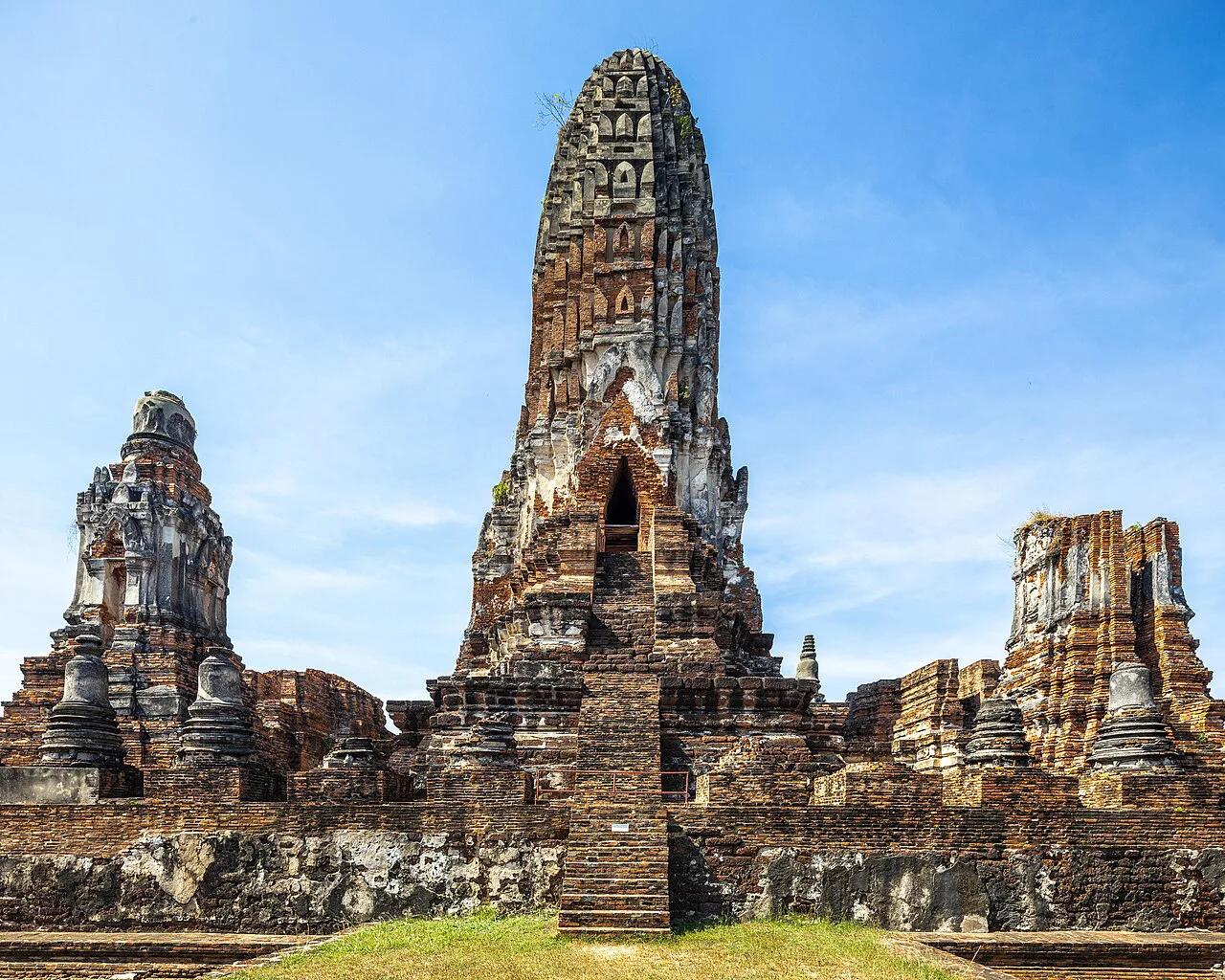
Wat Phra Ram is worth 30 to 45 minutes, and it earns them as a walk-through stop rather than a destination in its own right: a soaring Khmer-style prang on a stepped square platform, ringed by ruined stupas and leafy lawns. It sits in the middle of Ayutthaya's central temple cluster, almost directly across from Wat Phra Si Sanphet, so the practical question is not whether to go but where to slot it into your loop. This page covers its position in the historical park, the walking approach, what survives inside the walls, the founding story, the lake beside it, time budgets, and the hours and ticket details you should confirm with the Tourism Authority of Thailand rather than trust from a blog.
Where Wat Phra Ram sits inside Ayutthaya Historical Park
Wat Phra Ram stands in the center of the Ayutthaya Historical Park, roughly opposite Wat Phra Si Sanphet. That position makes it one of the easiest ruins to reach on foot if you are already working through the central cluster. The historical park itself is a UNESCO World Heritage Site, listed in 1991, and Wat Phra Ram is one of the monuments inside it.
Think of the temple as the eastern neighbor of the palace grounds: it lies outside the royal court complex on that side, facing the area around Wat Phra Mongkhon Bophit. If you are navigating by landmarks rather than street names, use Wat Phra Si Sanphet's three bell-shaped chedi as your reference point and walk from there. The surrounding cluster is dense enough that you can cover several ruins without a vehicle, which is the main reason to treat Wat Phra Ram as a stop on foot rather than a separate tuk-tuk trip.

How to get there: walking the central temple cluster
The simplest approach is on foot from Wat Phra Si Sanphet, which is close by and connected through the same road-and-lawn layout. Walkers report that the route between the two brings you to the back or side of Wat Phra Ram first, so you then follow the boundary wall around to the entrance you can actually use. Allow a few extra minutes for that circumnavigation instead of assuming the gate is on the side you arrive from.
If you are staying in the guesthouse strip across the river, bicycles and tuk-tuks are the usual alternatives to walking, and both make sense if you plan to string together the more distant ruins. The trade-off is straightforward: walking the central cluster costs you heat and time but saves fares, while a tuk-tuk gets you between widely spaced sites without melting. Whatever you choose, keep the temple's west-side entrance in mind when you ask a driver to drop you, since that is where you now enter.

What you actually see inside: the prang, the platform and the stupas
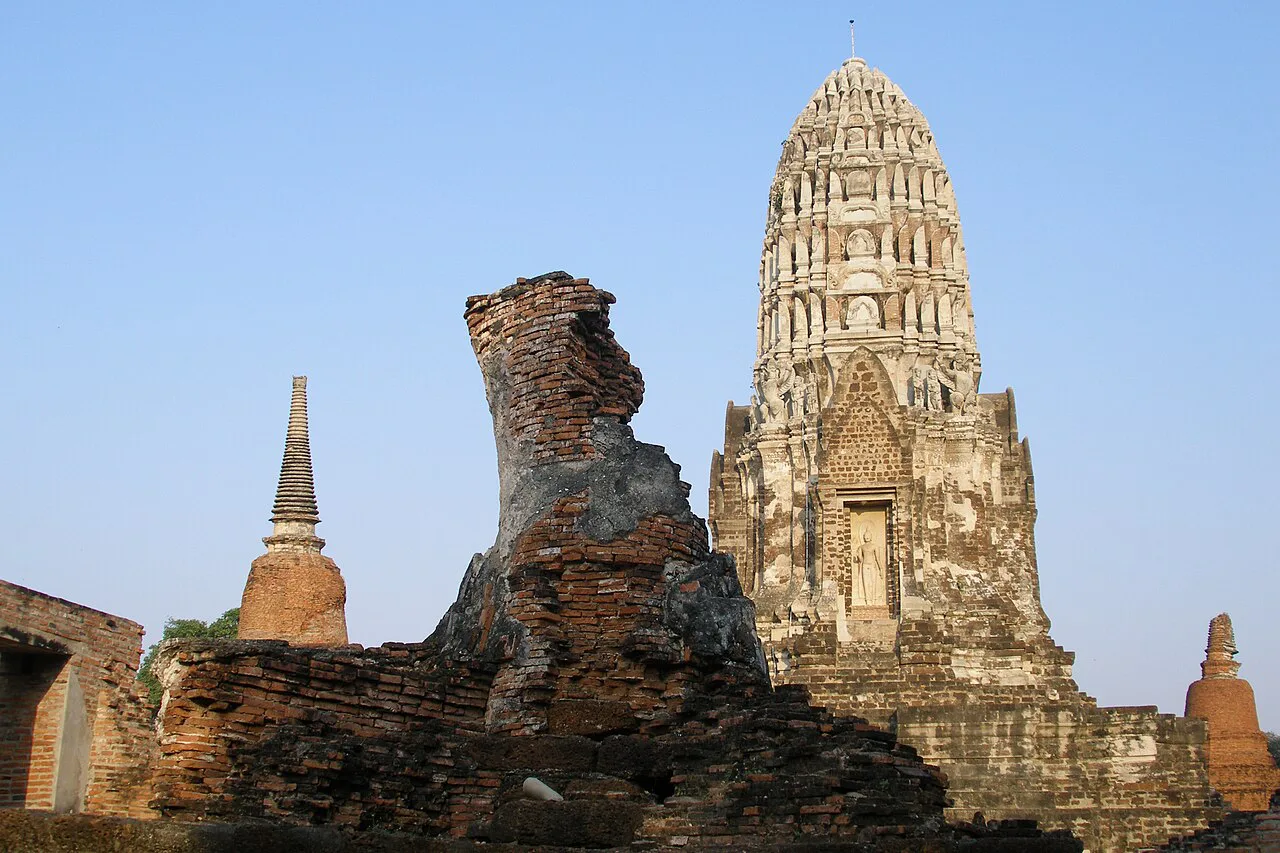
The centerpiece is the tall prang, a Khmer-influenced tower sitting on a massive square platform with tiered layers, which is why the temple is so recognizable from a distance. Around it, the debris includes the temple walls, pillars inside the ordination hall, several assembly halls, and dozens of small pagodas of assorted sizes scattered across the grounds. The effect is a compact but dense field of ruins rather than a single monument, so plan to walk a full circuit rather than photograph the tower and leave.
One detail that confuses first-time visitors is orientation: the original temple faced east, and you can still make out the ruined portico on that side, yet today you enter from the west. Understanding that reversal explains why the approach feels like arriving at the back of the complex. Look for the remains of stucco ornament on the structures — little survives, but enough to suggest how heavily decorated the temple once was.
Some accounts describe being able to climb partway up the main tower, but access rules at Ayutthaya ruins change and are not something to plan around. Treat any climb as a bonus if it is permitted on the day, and ask at the ticket point rather than assuming stairs are open. The platforms and thresholds are uneven, so closed shoes matter more here than at a paved temple.
Why the temple was founded here
Wat Phra Ram was founded in 1369 on the site where Ayutthaya's first king was cremated, which is the fact that gives the temple its name and its significance in the city's origin story. It was restored in the 15th century and then extended at intervals through the Ayutthaya period, so what you see is a palimpsest rather than a single building campaign. That layered history is the reason the plan reads as slightly puzzling on the ground.
If you want the political context — Ayutthaya as the old capital of the Thai kingdom before Bangkok — save it for a museum or a guidebook rather than reading plaques on site, which are limited. The Chao Sam Phraya national museum in town is the natural place to connect the ruins to the objects and chronology. It is a separate stop, not part of the Wat Phra Ram ticket.
Beung Phra Ram: add the lake and park, or skip it?
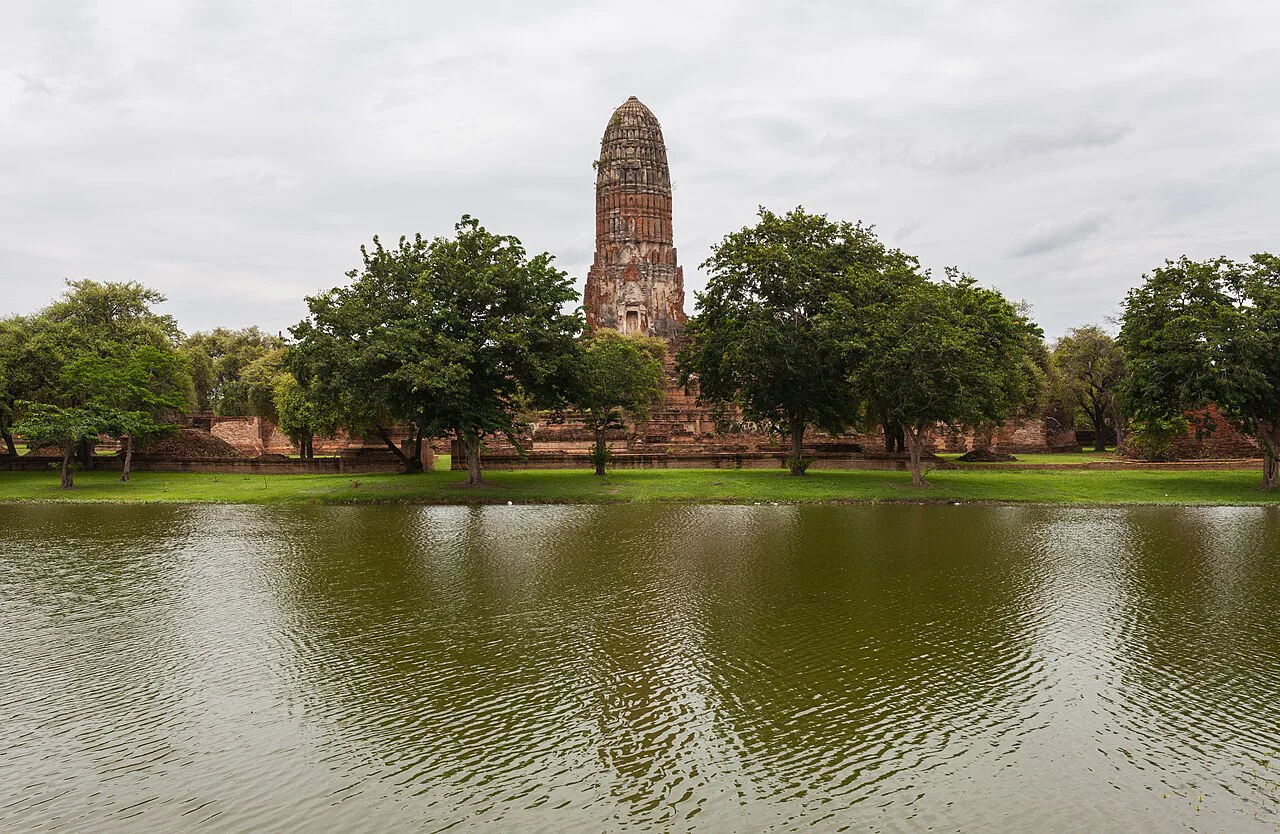
Beside the temple is Beung Phra Ram, a sizable lake with a park around it that may once have been part of the temple grounds. It is a real decision rather than scenery: the park is where local residents picnic and walk, and it gives you shade and a place to sit after the exposed platform. If you are hot and ahead of schedule, looping the lake is a pleasant 15 to 20 minutes; if you are behind, skip it without guilt.
How much time to allow
Budget 30 to 45 minutes for the temple itself, plus 15 to 20 if you add the lake. The grounds are compact compared with the big riverside ruins, so the time goes on circling the platform and reading the scattered foundations rather than on distance. Photographers should add more: the prang is the kind of structure that rewards several angles, and the trees frame it differently from each side.
If you are combining ruins, the sensible pacing is to walk the central cluster in one block and leave the river temples for a separate ride. Wat Phra Ram fits naturally between Wat Phra Si Sanphet and Wat Ratchaburana, both of which are within the same walkable area. Doing them on foot in the relative cool of the morning is easier than attempting the same route at midday.
Opening hours and admission: what to verify
Reported opening hours for Wat Phra Ram are 8:30 am to 5:00 pm, but that figure comes from third-party travel writing rather than an official park notice, so confirm it before you build a day around it. The reliable source is the Tourism Authority of Thailand's attraction page for Wat Phra Ram, which is the page to check for current hours and any closure notice. If you are arriving late in the afternoon, verify first rather than risk finding the gate closed.
Admission is where sources diverge most: one account notes a fee without giving a figure, another cites 50 baht for foreigners with a lower Thai rate and mentions a combined ticket covering several temples. Because those numbers are inconsistent and can change, do not budget from this page — check the official Tourism Authority of Thailand listing or the ticket window in Ayutthaya on the day you visit. If a combined ticket is on offer when you arrive, do the arithmetic against the number of ruins you actually plan to enter.
Heat, shade and the exposed platform
Wat Phra Ram is greener than most ruins in the cluster, with dense trees and maintained lawns that give you real shade around the edges of the compound. The platform itself is exposed, though, so the pattern that works is to cross the open center, then retreat to the trees to cool down. Carry water; vendors cluster around the main temple entrances but not reliably at every gate.
Visit early or late for both light and temperature, and wear shoes you can walk in on brick and laterite rather than sandals that slip on dust. A hat and a cloth for your neck make more difference here than an umbrella, which is awkward on the narrow platform steps. If you are heat-sensitive, pair Wat Phra Ram with a sit-down stop at the lake rather than pushing straight on to the next ruin.
What is nearby
Wat Phra Si Sanphet, with its three great bell-shaped chedi on the old palace grounds, is the closest major ruin and the obvious pairing; Wat Phra Mongkhon Bophit is nearby as well. Wat Ratchaburana, with its tall prang and crypt, is a short walk or cycle away and rewards a longer stop. Wat Mahathat, home of the Buddha head in the tree roots, sits in the same central area and is the busiest of the group.
Further out, Wat Phanan Choeng and its large seated Buddha, Luang Pho To, sit across the river and need a ride rather than a walk. Wat Thammikarat, with its roofless vihara and lion-guarded chedi, is another option near the palace end of the cluster. If you want a wider shortlist before committing your day, see Ayutthaya Attractions: 6 Visitor Guides and the full set of things to do in Ayutthaya for routes and how the ruins group geographically.
Is Wat Phra Ram worth adding to your loop?
Yes, as a 30- to 45-minute stop inside a walking loop rather than a standalone trip. Its central position, its distinct Khmer-style prang and the tree cover make it an easy add-on between Wat Phra Si Sanphet and Wat Ratchaburana. The rewards are architectural rather than atmospheric: this is a ruin to read, not a working temple to sit in.
Before you go, check the Tourism Authority of Thailand attraction page for current hours and admission, and decide whether the lake fits your schedule. Go early, carry water, and walk the central cluster rather than paying for short hops between adjacent gates.